Episode Transcript
[00:00:00] Speaker A: Welcome to Unsung Stewards, a podcast series presented by the Ripple Foundation.
I'm Becky Payne, President and CEO of Ripple and host of this series.
Our podcast spotlights and celebrates individual stewards, people working with others to create the conditions that everyone needs to thrive.
This season, I'm speaking to stewards who are strengthening our most important community asset, belonging and civic muscle.
Simply put, we are our most important resource.
We will only achieve a future where we all thrive together if we strengthen our civic ties and ensure that everyone everywhere feels that they belong in their communities and can contribute their hopes, aspirations and talent to the path forward.
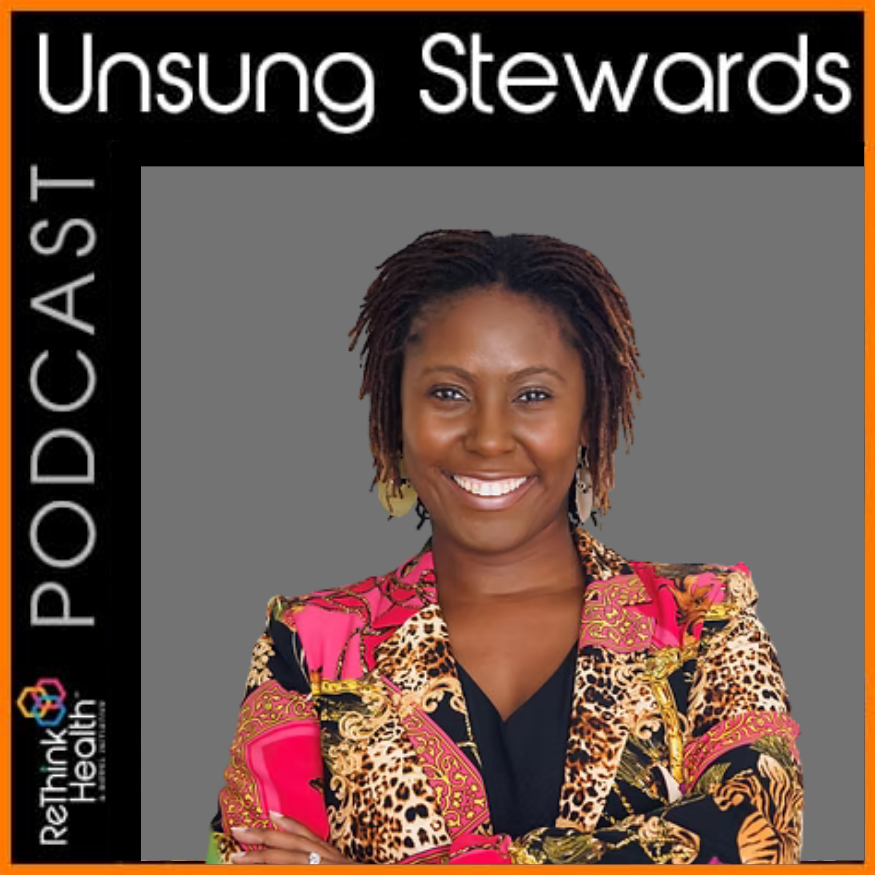
In this episode, I speak with Robin Wright Pierce, founder and CEO of Transforming Change, which helps leaders in social justice spaces work with intention towards a thriving future for all.
A longtime champion of individual and collective liberation, Robin has spent more than 15 years advocating for policy change, building community power, and helping people and institutions imagine more inclusive and effective ways of working.
Robin's practice is deeply rooted in her faith, and she considers building belonging and civic muscle to be a spiritual pursuit.
Before we begin, I want to offer a content warning.
This episode includes discussions of suicide, suicidal ideation, and depression. You may refer to the episode description for timestamps and guidance on how to skip those sections.
If you or someone you know is struggling or in crisis, help is available.
You can call or text 988 in the United States and Canada to reach the Suicide and Crisis Lifeline available 24 hours a day, seven days a week.
[00:01:56] Speaker B: Robyn, welcome. Thank you for agreeing to share your story with us here on the podcast. I'm so happy to have this time with you.
[00:02:05] Speaker C: Absolutely. I'm glad to be here with you.
[00:02:09] Speaker B: I'd like to start by inviting our guests to to share your story. The story of how you came to be where you are today in whatever form that takes for you.
[00:02:20] Speaker C: Yeah, so like many people in the work of love and liberation, in many ways I was baptized into the movement through trauma.
It's interesting in movement spaces, if you start asking people, why are you here? So often the stories are really riddled with stories of trauma. Right? It's some hardship that they encounter that really catapulted them into the work of justice. And really thinking about it, not just about their own predicament, but about how do you help others as well. And so in many ways, that's my story. Growing up in a family that oscillated between being working class and just downright poor, I could point to the fact that growing up, I moved 17 times. By the time I Went to college at the age of 17. Right. I could point to the. The violence that I witnessed in a community around me and so many other things. But there's really, I think, one story that really embodies why I am in this work today. So I grew up in Cincinnati, Ohio, and I attended Cincinnati public schools. And so in CPS schools, there's a lot of different types of schools that you could go to. There's one school, though, in particular at the high school level that is, like, really sought after in this region, and that's Wanda Hills High School.
I was one of the lucky students to test into this school and be able to attend Warner Hills. And so I started in seventh grade. And while I was doing good academically, I hated this school.
It was just the worst experience ever when I went there in junior high. I now know, as a mother of a rising high schooler, that junior high is kind of hard for everybody, no matter what. But some of it was just the difference that I encountered between my experience as someone who most of junior high was. We were unhoused and living with family, but the kids that I was going to school with seemed to have so much privilege. I really struggled socially to find my footing at this school.
And so I begged my mom for two years. I'm like, please let me leave this school. Please let me leave this school. And she just was not willing to let me leave the school. After all, it was the school that parents are wanting their kids to go to. And so, finally, going into ninth grade, we're at my older brother's football game. And so I go up to their principal, and I'm like, hey, Mr. Cease, I need you to convince my mom to let me come to your school. And so he came over with me, he talked to my mom, and he assured her that he'll look after me. He'll make sure I'm challenged, make sure I still get to college, right? So finally, she's like, okay, I'll let you leave the school. So I went to Hughes. And that's when I realized that here in CTS schools, two miles apart, one neighborhood over there, could be such different experiences for students in those schools. And so at Walnut, something that I thought was the norm, every student had their own textbooks, right? And we took them home with us, and we studied out of them. At Hues, there were just enough for the class. And so they didn't come home with us. They stayed in the classroom. At Walnut, there were over 100 clubs and activities that we could be a part of at Hughes, that wasn't the case. There were maybe 10 different options. But even beyond that, it was the difference in the academic rigor. The textbook that I used in 9th grade at Hughes was the same exact textbook we used in seventh grade for history at Wanton Hills. And so I realized very quickly that, wait a minute, there are different experiences happening across these schools less than two miles from each other.
Before that, so many of my experiences were like, okay, if I work hard and I do these things, I can maybe get myself out of this circumstance, right? Where I am today won't be where I'm always at. But that experience helped me to realize that I couldn't work my way to that level of privilege. There were kids at Wanda who, you know, lived in big houses with piano rooms and who took family vacations out of the country. And I could work as hard as I wanted to, and the people around me at Hughes could work hard all they wanted to, but they just didn't have the same opportunities. Right. There were actual circumstantial differences. And so that was my introduction into structural racism and structural inequality. And that really is what drove me to this work. I realized I could work hard and maybe I'll be successful, right? I could be that. That token who makes it out of the projects and who achieve all these things. But there are entire communities, many of whom look like me, who will never have the access to the resources that some of these other children have. And it has nothing to do with their parents caring about them, nothing to do with their hard work. It had everything to do with the way that our system was designed to make paths to college, paths to success, easier for some and a lot harder for others.
[00:07:15] Speaker B: It's such a powerful juxtaposition with one person. And all of that contextual support, all of the privilege of one school, in the absence of helping you feel like you belong in that space, couldn't overcome the differential experience. That plays right into the theme of this season on the podcast around belonging and civic muscle. So often people reflect on belonging and civic muscle as being a nice to do or a fluffy concept. But that story gives such a crystal clear example of why it's so important and the undermining that the absence of a sense of belonging can do.
[00:07:58] Speaker C: Absolutely. Because I literally begged to leave a school that was positioning me better because I didn't see how I belonged. And what I will add to that story is that I ultimately did graduate from Walnut Hills because that same principal let me come to his school when I was the Summer before my junior year, he called me and he said, I need you to go back to Walnut. And I said, but I don't like that school. I love it here. I don't want to go back. And he was like, we can't challenge you the way that they can. You should go to the school that's going to help you get to college and have the most possible success. And so I ultimately listened, and I went back to Walnut and graduated from there. And it was a little better, you know, by junior year, school is just easier than middle school in general. But it was still not. I still didn't have my people, right?
[00:08:48] Speaker B: And we can't rely on everybody, nor should we ask of everybody to be as resilient as you had to be in order to make those transitions.
In my view, that's a hill too high. Talk to me about Transforming Change, the organization you founded, how did that come to be?
[00:09:08] Speaker C: As I became clear that I wanted to do work of justice, I kind of started my career in the social justice space working with nonprofit organizations that were also trying to make the world a better place, right? So that the hills that folks had to climb weren't quite so high.
I realized that there was something amiss in the movement, right?
There were far too many folks in that work who were drowning while trying to save someone else.
I realized that we in the social justice space were doing the work of demanding justice in the systems around us. But in many of our organizations, we were perpetuating injustice in how we operated. We were using the empire's tools while trying to dismantle the Empire's house, right? I realized that our vision was even being filtered through the lens of empire, of oppression, of the world that we've been handed. Even as we were trying to shape a new vision, we were constraining ourselves, that our strategies were failing, in my opinion, to meet the magnitude of this moment and what is required of us to build a beloved community. And so I found it transforming Change because I believe that our pursuit of justice in the world around us hinges on and is intrinsically connected to our pursuit of justice within ourselves and among ourselves in the movement. My work with Transforming Change is to help transform leaders so that those on the front lines of change work aren't leaving themselves out of that work, but that we're bringing ourselves into it, tending to our own pain, tending to our own need for liberation within as we are working to pursue it around us. And we do the work of transforming strategy, really starting to ask the question of how do we think about this differently in this moment of the rise of authoritarianism. What got us here won't get us there. So that's the work of Transforming Change. It was really born out of my own experiences in the movement and wrestling with my own liberation, my own felt sense of freedom, and how it feels to operate within a collective together to pursue justice, and how we might begin to do that differently.
[00:11:30] Speaker B: For leaders who want to do this work, I can say it's hard to find outside support to help you. I really appreciate that's the focus of Transforming Change and the deep expertise that you bring.
I know that some of that expertise comes from your own experience and in particular the connection to your own faith and spirituality. So I wonder if you would share a little bit more about that connection. As we've already mentioned, we're talking about belonging and civic muscle. We often talk about when we think about shared stewardship and this connection to spirituality, we have started to talk about spirited stewardship. But it is a term that doesn't have deep definition yet. So I want to invite you to help us bring some substance and some language that will help expose others to that connection.
[00:12:18] Speaker C: So faith for me has been critical in the work of belonging in civic muscle, the work of transformation, the work of healing and restoration, the work of justice, love and liberation. I want to share a little story because this has been critical to my own faith development and really my whole thinking on what it means to do this work and how do we do this work today? How do we do this work? Perhaps in different ways that are restorative.
In 2019, a dear friend of mine, Amber Evans, who was an activist in Columbus, Ohio, but really statewide known, she committed suicide.
Amber was just a delight in so many ways. She had a glow about her. She loved children. She was deeply committed to youth and juvenile justice and decarceration and immigration justice and so many other things that we're still fighting for today. And she was 28 at the time that she committed suicide.
And I remember no one wanted to believe it because Amber just seemed so full of joy every time we were around her, right? Just a little bit before that, she was playing with my son, who was 4 or 5 at the time, and she was chasing him around, pretending to be a dinosaur. And I just have so many memories of joyful moments with her.
And people were in complete disbelief, right? Like, how is it that someone who seemed so happy all the time, who was fighting for justice, doing the good work, could take their own lives?
But if I'm honest, I Kind of understood it, right? Because for years up until that point, I have been struggling with depression, struggling with hopelessness, struggling with anxiety, and so many other things that were quietly wreaking havoc in my life even while I was on the front lines of trying to do justice work.
And so I understood how it could be that someone might be on the front lines of the work, may outwardly present one particular way, but internally not be doing well.
And so that moment, and the reason that I'm talking about that in the face of faith, in this question around spirited stewardship, is because I've realized since that moment, as I have started to really take more seriously, and not that I wasn't taking my healing seriously before, but in that moment, something shifted. Where I was like, okay, I have to go deeper in this or I'm next, was really the thought that I had. And I would look at my little boy and say, I can't be next. And so I have to go deeper in my pursuit of healing and restoration. And I really have to figure out how is it possible for me to hold. Both to hold myself with care, to. To find healing and restoration within while also doing the work of justice. And I found for me that pursuit inevitably led me to deeper faith.
As I was doing the work of trying to find myself in the midst of all of this, I also found my version of God. And I realized how so much of my hopelessness was tied to my lack of faith, that something else was possible at that time. And so I was fighting for something else because I just couldn't stand for what was. But I didn't have a lot of hope in my work. And so for me, hope, faith, the knowing of the interconnectedness of all of us and all that we do, all those things are tied together and my belief are critical to our pursuit of justice. And without it, we're at risk of losing ourselves. We're at risk of not being able to be effective in our work. We're at risk of not being able to be alongside others in the work, which is critical for the work to happen. Right? That's a roundabout way of saying that for me, faith, belonging, civic muscle, all these things are interconnected. Freedom is personal and political.
We have to bring ourselves into it. And at the root of all of that work is a faith in the righteousness of our cause. It's a faith that God is with us in this work. However we conceive of God. It's a faith that something else is possible beyond what we can see, and that drives us to keep going, even when systems of oppression are incentivizing us to give up and to compromise on our values and to scapegoat away the least of the in pursuit of our own personal safety. All of these things are connected for me.
[00:17:08] Speaker B: Yeah, it brings up for me this idea of scarcity versus abundance. It's not just that stewards have to join with others, we do.
And the ultimate pursuit is that I can't achieve what I'm fighting for if others are still suffering and struggling around me. And yet there is a very different narrative and perspective and strategy that pits are thriving in well being against each other, as though there's a finite amount of that available to us. But what I'm hearing you describe is how much it's important to hold on to the hope that not only is a different future possible, but we will only get there by bringing everybody along with us. And then the deep internal work that it takes to tap into that as
[00:18:00] Speaker C: a core value, I think that's my.
That's so good. So at transforming change, we have a Finding Freedom framework.
Myself and my colleague Nelson, pulling together our wisdom and knowing alongside what we've learned and in conversation with others.
One of the core aspects of our Finding Freedom framework is community and a belief that our own liberation hinges on community.
Right. And yeah, we can do the work, we can do somatic practices to find our own grounding and to really settle our nervous systems and all those things that's good and needed. But it's gonna be the community around you that either reinforce your movement toward freedom or who perpetuate movement toward oppression and bondage. And I think the same is true for our justice pursuit because it's what I have found for myself is the deeper I go in my own work of freedom, the more I can't ignore how my freedom is tied to someone else's.
None of us got here on our own, our own accident, right? It's all the people around us who shaped us, who supported us, who picked us up when we failed, who told us to keep on keeping on when it was hard, all those people who made it possible. And so as we learn to see the fuller story for our own lives and connect that to fuller stories of history, then it becomes natural to understand that all of this is about all of us together and that there's something that's possible together that just isn't possible alone.
The individual, the organizational, the group work around coalitions and movements, all these layers of transformation are so important.
[00:19:53] Speaker B: Yeah.
I wonder if you could Go a little deeper on this and share what this idea looks like in practice. What does this idea of spiritually connected, faith connected stewardship and justice oriented work look like when you put it into practice on the ground?
[00:20:13] Speaker C: I think the most prominent example for me is faith based organizing and the work of community organizing. That's rooted in faith. And it's not just we're driven by our faith to do the work that we're doing. Our faith ties us together. Our connection to our churches, our synagogues, our mosques, and that community ties us together and is the foundation of the pursuit of justice.
For most of black social justice movements, that's what that work has looked like. But I think on the more present level, what we try to do in our work with Transforming Change is we try to integrate all of these levels of transformation in our work. And we just got finished working with a cohort of six organizations in the Greater Cincinnati area who are trying to deepen their policy advocacy work. And we could have gone about it in a way that most of these training academies go about it, but instead, most of that was around connection building, grounding and restoration. And so for us, part of that is starting with relationships, starting with centering and meditation, integrating that into our work. So we opened up this workshop with a bunch of people who didn't know us yet, saying, let's take a moment to get centered and grounded before doing anything else. We spent extensive time allowing people to share their stories. One of the things that I believe is that to be witnessed is to belong. And so often in a work of justice, we're jumping into the nitty gritty and the tasks, and we don't take the time to actually bear witness to who one another are, right? And those are the moments, those are the stories or the fabrics that weave together to support the foundation of what we're doing. And so for us, we integrate those things into our work. And so, yes, they learned about policy details. Yes, they learned how to cut their issue and how to do those things. And that anybody could have taught them. What made their experience with us different was we integrated all of these facets into the work and challenge them to say, how are you connecting yourself into this? In a society that tells us to isolate, to not trust, to stay separate, revealing a little bit of who you are to people in the room with you is an act of courage.
Seeing yourself in others and allowing others to see themselves in you fuels courage to do the harder things that we're going to have to do in justice.
[00:22:47] Speaker B: And I imagine it Also sparks creativity and ways of identifying assets and strengths of people in the room that you would have never known if you're just a title and an organization and a workshop.
[00:23:02] Speaker C: Absolutely, absolutely. We have a leadership development framework that we call the Wise Warrior.
And the Wise Warrior is a set of archetypes of what we've noticed in the movement ecosystem over the years. And it's really an invitation in a lot of ways into a different way of being in the work of justice. A wise warrior, soulful, is grounded, is rooted in their faith, rooted in community.
A wise warrior is able to have discernment as they're navigating their word, to operate with courage and clarity. We believe that now more than ever, we have to have wise warriors. I think part of what we were seeing was like, okay, there are so many leaders who are leaving themselves out of the work. So many leaders who are chaotic or rigid or in chaos and unable to be grounded in the face of challenge. So many leaders who are unintentionally perpetuating the same oppression that they're fighting externally. And so who do we need to be to actually usher us into the next era?
[00:24:14] Speaker B: It's a beautiful framework.
Thank you.
I want to talk a little bit about hope, because you take us back to where we started, the harm that an absence of hope can create, the loneliness, the perpetuation of struggling and suffering, and when hope is present, when we can cultivate hope in ourselves, in others, and in the future, what that gives us. So could you talk a little bit first about how you continue to seek and find hope and then what is giving you hope right now?
[00:24:50] Speaker C: For me, my hope is intrinsically tied to my faith.
And at our church, beloved Community Church, we. One of the things we believe is that God is always on the side of the oppressed in a struggle for freedom, and that our work is to join into that struggle and to meet God in that work.
And so, for me, knowing that even when it seems like chaos is ensuing all around us, and even in moments like now, where, quite frankly, those with the most political power in our nation are not as committed to love and justice as I would like them to be, even in this moment of imbalance of power, God is still with us in the struggle. And what I'm pulling hope from today is my engagement with organizations that are doing the work of justice, and not just in my role and work at transforming change, but just as a resident and individual in the community who's involved. Right. I'm a part of an organization here called Communities United for action.
And it's a 40 plus year old organization of everyday people committed to creating better world.
And for me, being alongside people is what gives you hope. Malcolm X once said that every black person should belong to an organization.
And I believe that every person should belong to an organization. Right. One of the things that is characteristic of authoritative regimes is evoking chaos.
Every day you turn on the news, there's 50 new things that we need to fight.
But joining into an organization that has your shared values with other people who are committed to the good fight will help you to focus your attention, to carve out a space where it's like, I don't have to answer all the things, but here's what we are doing together and to be alongside other people who can remind you you're not crazy.
This isn't okay. And we can work together to do something. Find you some organization that you can be a part of that can help you filter through the chaos to find your slice of the work in community with others to help build a world of love and liberation.
[00:27:23] Speaker B: That's such an important message. No one of us is responsible for all of it, but collectively we can take on all of it.
Robyn, thank you so much for joining us.
[00:27:32] Speaker C: Thank you, Becky, for the invitation.
[00:27:35] Speaker A: Thank you for listening to this episode of Unsung Stewards. We hope you took inspiration that will help you grow your own stewardship of a thriving future for all.
I want to thank Robin for joining us and for her commitment to helping leaders around the country transform their practices with love.
I'd also like to thank the team that makes this podcast possible, Molly Belsky, Layla Hussain, Amy gold and Amanda McIntosh. If you liked this episode and want to hear others, you can rate and review this podcast or follow us on your favorite podcast app.
I'm your host, Becky Payne. To learn more about our guests and their work, please visit our website at ripple. Org R I P P E L Org we all hold deep gratitude for those who've been willing to share their stories with us.